Egypt’s Ancient World Awaits
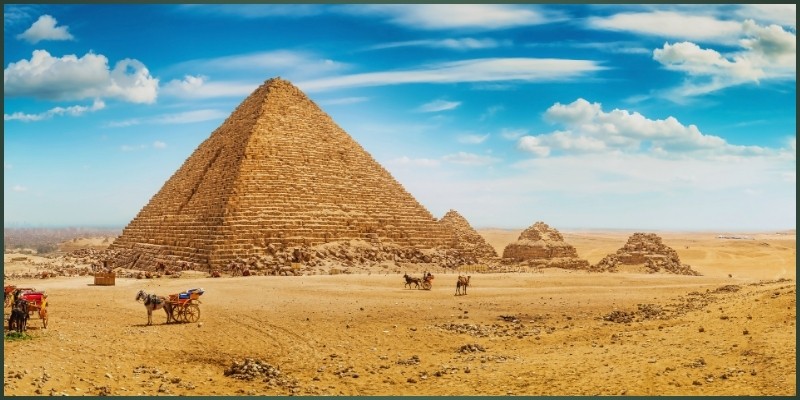
There are places in the world where history is something you read about, and then there is Egypt, where history seems to breathe. Here, the stories of gods and pharaohs are carved into stone, painted on ancient walls and preserved beneath layers of linen and resin. The sun still rises over the Nile as it did thousands of years ago, casting its golden light across monuments built for eternity. For anyone fascinated by mythology, ancient cosmologies and forgotten pantheons, Egypt offers something extraordinary. You can stand face-to-face with the material remains of a civilisation that imagined the universe in poetic terms. And for those who know little about Egyptian history or mythology, they can still find themselves captivated by the chance to encounter that world in a very real and tangible way.
Beyond the temples and the pyramids, three museums belong at the heart of that history. The Grand Egyptian Museum, the Egyptian Museum in Tahrir Square and the National Museum of Egyptian Civilization.
The Grand Egyptian Museum
Near the pyramids of Giza, the newly opened Grand Egyptian Museum is an extraordinary first encounter. The world’s largest museum dedicated to a single civilization, it is monumental in both scale and ambition. Its vast spaces are filled with the objects of a civilization that flourished for thousands of years, while enormous windows and terraces draw your gaze towards the pyramids themselves. It is a surreal feeling to stand inside a modern museum and see, in the distance, monuments built more than 4,500 years ago.
The museum’s great treasure is the Tutankhamun collection, bringing together more than 5,000 objects from the young king’s tomb. Gold jewellery, ceremonial objects, furniture and funerary treasures reveal a world in which death was understood not as an ending, but as a passage into another existence. Even if you know nothing about Tutankhamun, the sheer beauty of the objects is overwhelming. Gold catches the light, intricate patterns emerge from objects crafted thousands of years ago and suddenly the distant world of the pharaohs feels surprisingly human.
Then there is the colossal statue of Ramesses II in the Grand Hall. Stand beneath it and look up at the enormous carved face before stepping outside into the Egyptian sunlight. With the pyramids rising across the horizon, it is one of those rare travel moments when the scale of history becomes almost impossible to comprehend.
The Egyptian Museum
Back in central Cairo, the Egyptian Museum in Tahrir Square offers a different kind of magic. Opened in 1902, it feels like an archaeological treasure house, its galleries filled with statues, coffins, jewellery, papyrus and objects collected from across Egypt. Wander through its rooms without worrying about knowing what everything means. Let the objects surprise you. A beautifully painted coffin, a tiny piece of jewellery or an enormous weathered statue can tell its own story.
And then there is Tutankhamun’s famous golden mask. Familiar from countless photographs, it is still astonishing in person. The polished gold, deep blue details and serene expression seem almost luminous beneath the museum lights. For enthusiasts, it is an iconic masterpiece. For first-time visitors, it can be the moment when ancient Egypt suddenly becomes real.
The National Museum of Egyptian Civilization
At the National Museum of Egyptian Civilization, the story expands beyond the pharaohs. The museum traces Egypt through thousands of years, from ancient kingdoms to the Greek and Roman periods, Coptic Christianity, Islamic Egypt and the modern nation. Its Royal Mummies Gallery is an unforgettable highlight. In the atmospheric chambers, you come face-to-face with the preserved remains of rulers, including Hatshepsut and Ramesses II. After seeing their statues and names throughout Egypt, encountering the people themselves is deeply moving.
For those curious about mythology, these museums offer an introduction without requiring a textbook. You begin to recognize the familiar forms. The falcon, the jackal, the cat, the scarab. You encounter Ra, associated with the sun; Osiris, the ruler of the afterlife; Isis, a powerful symbol of magic and protection; and Anubis, the mysterious guardian of the dead. Their stories explain something fundamental about ancient Egypt. The Egyptians looked at the sun, river, animals, stars and desert around them and imagined a universe in which everything was connected. This is what makes Egypt so compelling.
Follow the stories, marvel at the gold, look up at a colossal pharaoh and let the city carry you from the modern to the ancient. By the time you leave, the names may no longer feel like names from a history book. Tutankhamun has a face. Ramesses has a presence. The gods have begun to emerge from the symbols and stories. And somewhere between the museum lights, the Nile, the cafés and the desert horizon, ancient Egypt no longer feels like a distant civilisation.